How SmartHoldem Solved the Blockchain Trilemma Without Data Centers
In the blockchain industry, there's a long-standing unwritten rule: high speed comes at the cost of decentralization.
If you want sub-second finality, you'll have to accept that only corporations with $50,000 servers and gigabit connections can be validators. If you want true decentralization (like Bitcoin), prepare to wait an hour for transaction confirmation.
But what if this is a false choice?
The SmartHoldem team is proving that it doesn't have to be this way. Thanks to a complete rewrite of the core in Rust and the implementation of next-generation transport (Iroh QUIC), we've achieved deterministic finality in 8 seconds, while maintaining the ability to run a full validating node on an ordinary laptop behind a home router.
This isn't a compromise. This is the new Web 4.0 standard.
The Fast Finality Club: Who Are We Comparing Ourselves To?
When we talk about deterministic finality (the moment when a transaction is mathematically impossible to reverse or rewrite), SmartHoldem with its BFT gadget (SHIP-35) enters the same tier as the industry elite:
- Cosmos (Tendermint): ~6–7 seconds
- Avalanche: ~1–3 seconds
- Polygon PoS: ~2–3 seconds
- Algorand: ~3–4 seconds
- SmartHoldem (BFT): 8 seconds (1 slot)
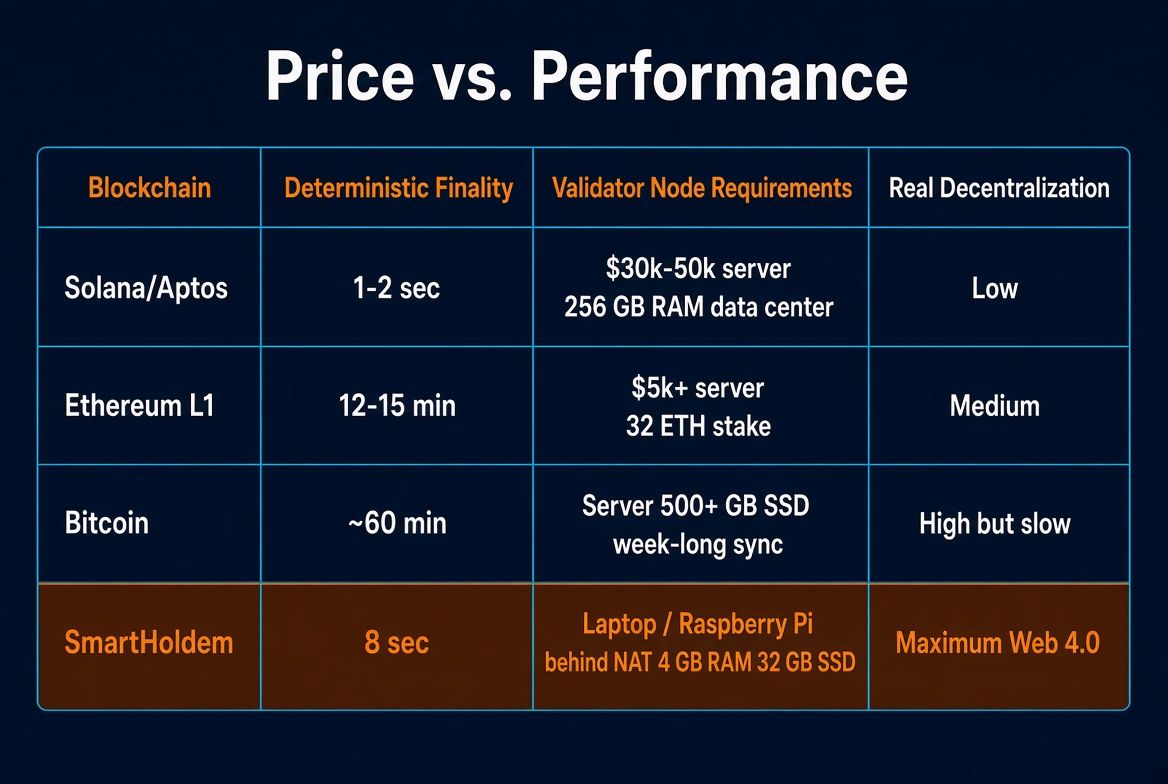
For comparison: Bitcoin requires ~60 minutes (6 confirmations), Ethereum (L1) — ~12–15 minutes, and classic DPoS without BFT — about 3 minutes for a full round.
At first glance, it might seem that 8 seconds is "slower" than Solana's or Aptos's 1-second finality. But the devil is in the architectural details.
The Illusion of Speed: The Price of Sub-Second Consensus
Networks that boast finality in under a second pay a high price for it: hyper-centralization of hardware.
To be a validator in Solana or Aptos today, you need:
- 256 GB+ of RAM
- 12+ latest-generation CPU cores
- NVMe drives of several terabytes with extreme write speeds
- A dedicated gigabit connection in a data center (colocation)
Result: a "decentralized" network that can realistically be supported only by a few thousand nodes concentrated in AWS, Hetzner, or OVH data centers. If these data centers lose power or receive a regulatory order, the network goes down. This isn't Web 3.0. This is Web 2.0 with cryptography.
The SmartHoldem Phenomenon: "The Sweet Spot"
We set a different goal: achieve speed sufficient for instant settlements and Web2-level UX (8 seconds), while preserving the ability for any user to participate in consensus.
How did we do it?
1. Rust Core and Parallel Processing
We completely abandoned Node.js and PostgreSQL. The new sth-core-pq core in Rust uses the embedded Sled database with zstd compression.
Result: a block of 500 transactions is locally verified and applied in ~50 milliseconds. No overhead from bytecode interpretation or heavy SQL queries.
2. Iroh Transport (QUIC) and NAT Traversal
This is our killer feature. Traditional blockchains require nodes to have a static IP address and open ports.
SmartHoldem uses the Iroh protocol (based on QUIC/UDP). It supports NAT traversal and hole punching.
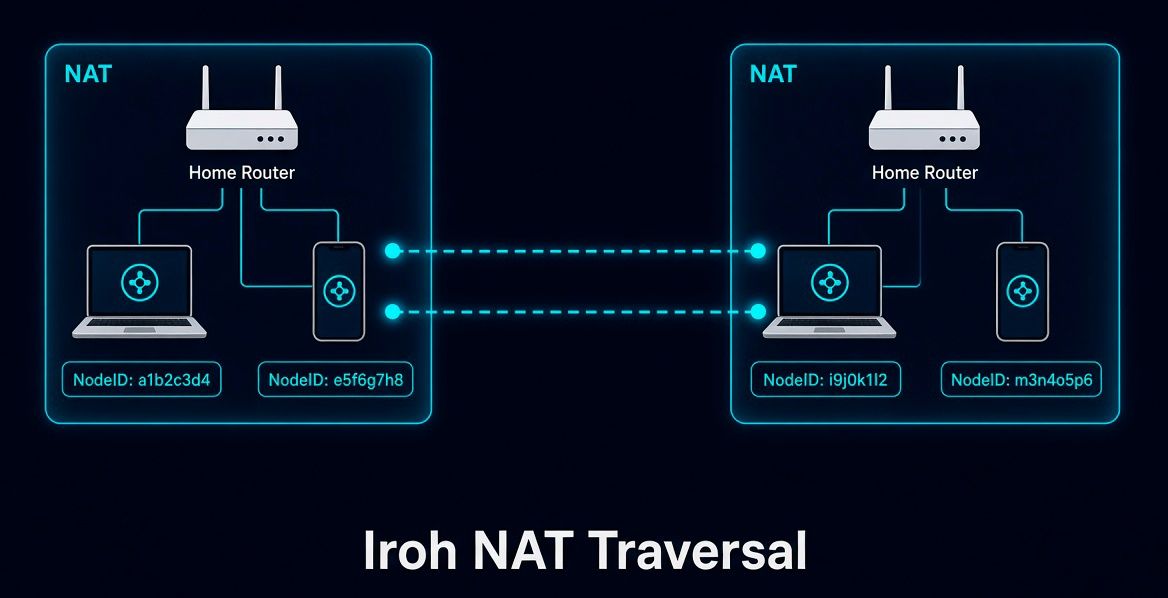
Result: your node can be behind a regular home Wi-Fi router, without a public IP address. The network will find it by its cryptographic identifier (NodeID) and establish a direct encrypted connection.
The transport layer follows a dual-stack architecture. Primary communication occurs over the decentralized Iroh mesh, while a legacy WebSocket/Protobuf bridge (port 4001) is maintained strictly for backward compatibility with nodes on servers.
3. BFT Gadget
Instead of waiting 3 minutes for 21 delegates to sequentially create blocks in a round, we implemented a Byzantine Fault Tolerance mechanism. As soon as a block receives signatures from 15 out of 21 active delegates via fast Iroh gossip, it becomes final. Finality is reached within 1 slot (8 seconds).
Why This Changes the Rules for Web 4.0
In the Web 4.0 paradigm (described in Netfory Whitepaper - A Peer-to-Peer Electronic Application and Data Distribution Network), the blockchain ceases to be the "main computational engine" and becomes a decentralized trust and settlement layer. Most activity (messengers, dApps, storage) happens in the P2P network (Netfory Web4 OS).
But for this P2P network to be truly sovereign, its economic and consensus layer must be accessible to everyone.
If a data center is needed to run a node, the network is controlled by corporations.
If a student can run a node on a Raspberry Pi in a dorm room or a freelancer on a MacBook in a café — the network belongs to the people.
The Proof-of-Utility model in Netfory SmartNet rewards exactly these participants: you get rewarded in STH simply for keeping an application running and sharing resources, without requiring an engineering degree to set up a server.
SmartHoldem also integrates hybrid post-quantum cryptography (ML-DSA-44, NIST FIPS 204), making it resistant to future quantum attacks while maintaining backward compatibility.
SmartHoldem isn't trying to be the fastest blockchain on paper at any cost. We strive to be the most balanced.
We've proven that you can achieve Cosmos- or Polygon-level finality without sacrificing the principle that "anyone can be a node".
All of this runs on Netfory - the Web 4.0 OS that brings decentralized storage and app store, DevHub (Web4 "GitHub"), censorship-resistant dVPN, E2EE messaging and more.
The future of decentralization isn't built in Amazon server racks. It runs on your laptop.
Don't just visit the web. Be the web.
Download Netfory Web4 OS: https://github.com/NETFORY
Run a SmartHoldem Node in 5 Minutes: https://github.com/smartholdem/sth-core-pq
#SmartHoldem #Web4 #BlockchainTrilemma #Decentralization #Rust #Iroh #QUIC #PostQuantum #Netfory #STH #DPoS #BFT #P2P #Crypto