
🛡️ SmartHoldem: Quantum Shield
🛡️ SmartHoldem: Quantum Shield. How We Protect the Blockchain from Future Computers.
While the market discusses charts and volatility, a threat capable of nullifying classical cryptography is maturing in the labs of tech giants. Shor's algorithm on a sufficiently powerful quantum computer could break ECDSA (elliptic curves) - the mathematical foundation on which wallets and transactions for most blockchains, including SmartHoldem, are built today.
We aren't waiting for a hypothetical "Day X." The integration of Post-Quantum Cryptography (PQC) into the SmartHoldem ecosystem has already begun. Below is a detailed breakdown of our roadmap for the post-quantum era.
1. What is the main vulnerability of modern networks?
Blockchain cryptography relies on one-way functions: it's easy to generate a public key from a private one, but practically impossible to reverse on classical computers. Quantum algorithms break this paradigm. If a malicious actor gains access to a sufficiently powerful quantum stack, the key generation mechanism becomes "transparent." Under these conditions, even a strong passphrase won't save you, as the vulnerability lies in the mathematical basis itself, not in user data.
2. The Arsenal: Which algorithms are we choosing?
Developing cryptography from scratch is an unjustified risk without years of independent audit. SmartHoldem is aligning with finalists from the NIST standardization competition and time-tested schemes:
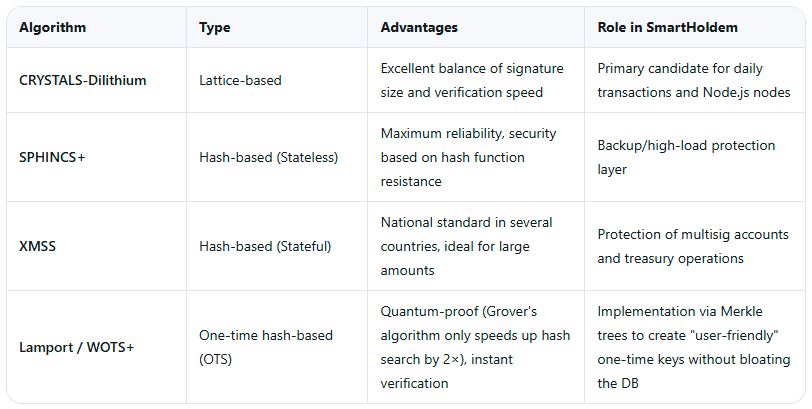
3. Implementation Plan: Hybrid Model
We are ruling out abrupt hard forks and forced migrations. The transition will be gradual and seamless:
Stage 1: Hybrid Signatures
Transactions will be signed simultaneously with classic ECDSA and a new PQC algorithm (e.g., Dilithium). Even if one method is compromised, the other will maintain protection.
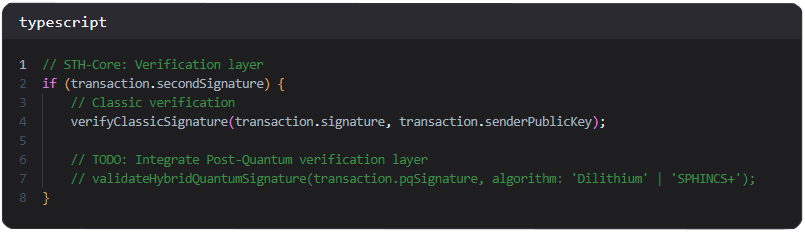
Stage 2: Updating STH-Core
Since the SmartHoldem node is written in TypeScript/Node.js, we will integrate optimized PQC libraries in Rust or C++ via node-addon-api. This maintains the high throughput of the DPoS network without sacrificing cryptographic strength.
Stage 3: Quantum Addresses
Introduction of a new address type with extended public keys resistant to quantum analysis. Users will be able to gradually transfer funds to "Quantum-Safe" wallets.
4. Killer Feature: Hybrid Quantum Shield via Second Signature
Unlike many networks where users would have to create new wallets and mass-transfer assets, SmartHoldem leverages a unique architectural feature — the second signature mechanism.
How it works:
- An address in SmartHoldem is formed as a hash of the first public key.
- When the second signature is activated, a second public key is recorded on the blockchain.
- We replace the generation of this second key from ECDSA with a post-quantum algorithm.
Result: You do not need to change your wallet. When you activate the second passphrase, the system automatically applies a "post-quantum lock" to your account. Your address remains the same, your coins stay exactly where they have been for years, but now they are protected by a second cryptographic layer. Even if a quantum computer computes your first private key, it cannot send a transaction without a valid second (quantum-resistant) signature. The SmartHoldem node will simply reject the attempt.
For users on a single signature: You will need to either activate a second signature (which instantly enables quantum protection) or transfer funds to the new address types once they are released.
5. Technical Nuances & Network Protection
- Delegates under protection: In a DPoS network, delegates sign blocks. Forging their signatures threatens the entire blockchain's integrity. Implementing PQC at the protocol level makes SmartHoldem a "digital fortress" resistant to consensus spoofing.
- Transaction size: Hash-based schemes (Lamport/SPHINCS+) generate signatures sized in kilobytes. Node logic will be adapted to correctly process "heavy" transactions without losing sync speed.
- OTS Optimization: To avoid bloating the blockchain, one-time keys will be aggregated into Merkle trees. For the user, this looks like a familiar wallet, but at the mathematical level, each key is used strictly once and invalidated after signing.
Code in Progress
We are already preparing the infrastructure for the new verification layer. Here's a glimpse of how the integration will look in the core:
Quantum supremacy is not the end of cryptography, but its next evolutionary stage.
SmartHoldem isn't adapting retroactively. We are laying the foundation for the future today. We are choosing mathematics that cannot be "solved" by brute force and integrating it directly into the core of our DPoS network.
The future is already here. And it is secured.