
SmartHoldem · DPoS Blockchain
SmartHoldem Blockchain: Web 3.0 & Web 4.0 Ready
High-Performance DPoS Blockchain Infrastructure
SmartHoldem blockchain serves as the trust layer for both Web 3.0 decentralized applications and Web 4.0 autonomous agent networks. Our battle-tested infrastructure powers seamless value transfer and state management across the symbiotic web.
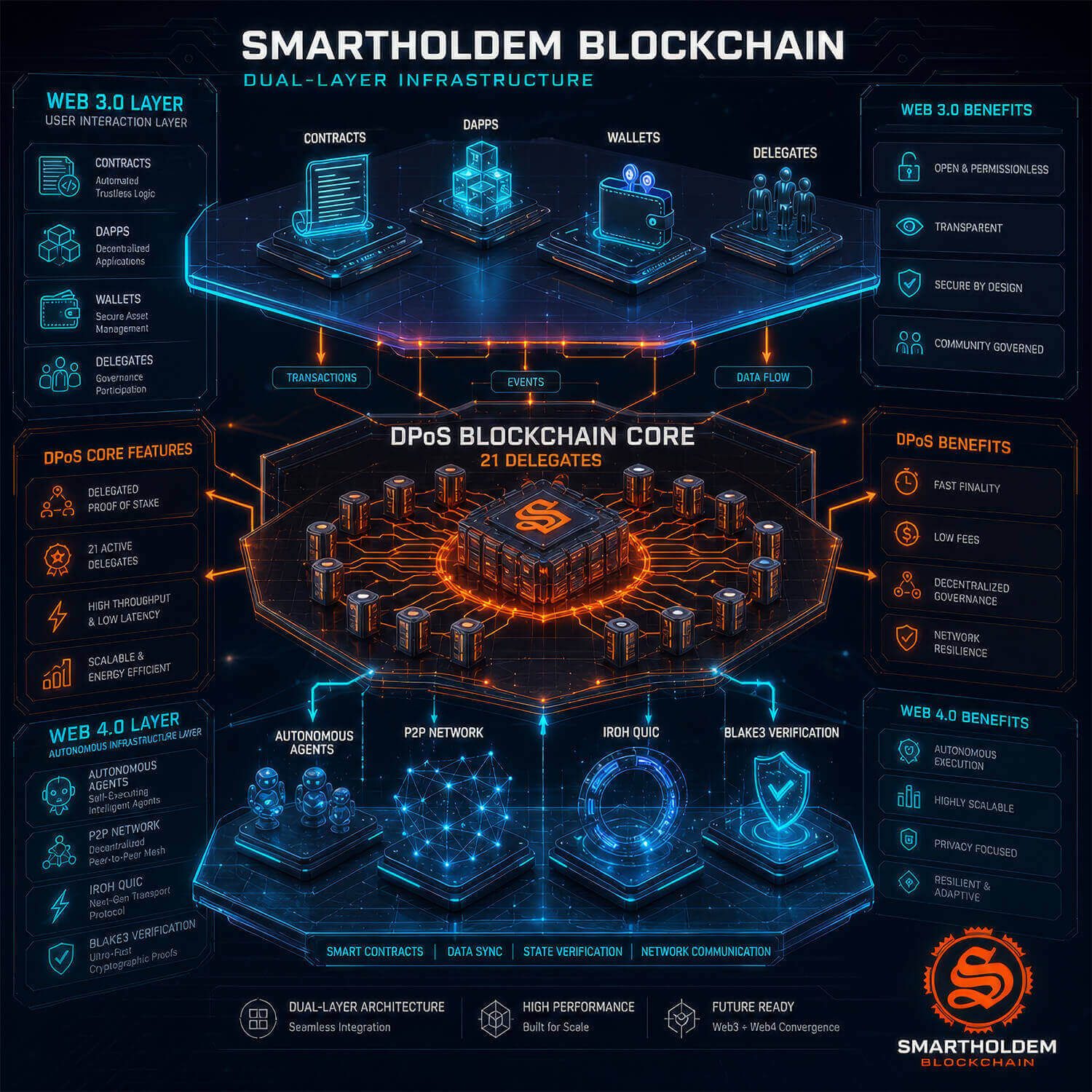
Hover to explore the dual-layer architecture
Speed & Scale
Built for Speed and Scale
SmartHoldem supports dynamic hash rates depending on transaction load. Easily scalable by x100 or x10000 to meet growing demand.
8-Second Block Times
Lightning-fast finality powered by Byzantine Fault Tolerance (BFT). Blocks are always completed and can never be reverted.
Dynamic Scalability
The network effortlessly scales to handle high-throughput applications, including demanding Web3 & Web4 ecosystems.
Eco-Friendly Consensus
DPoS is highly energy-efficient and scalable, offering faster and more affordable transactions compared to legacy PoW and PoS networks.
Benchmarks
Performance Benchmarks
Real-world load testing confirms enterprise-grade scalability
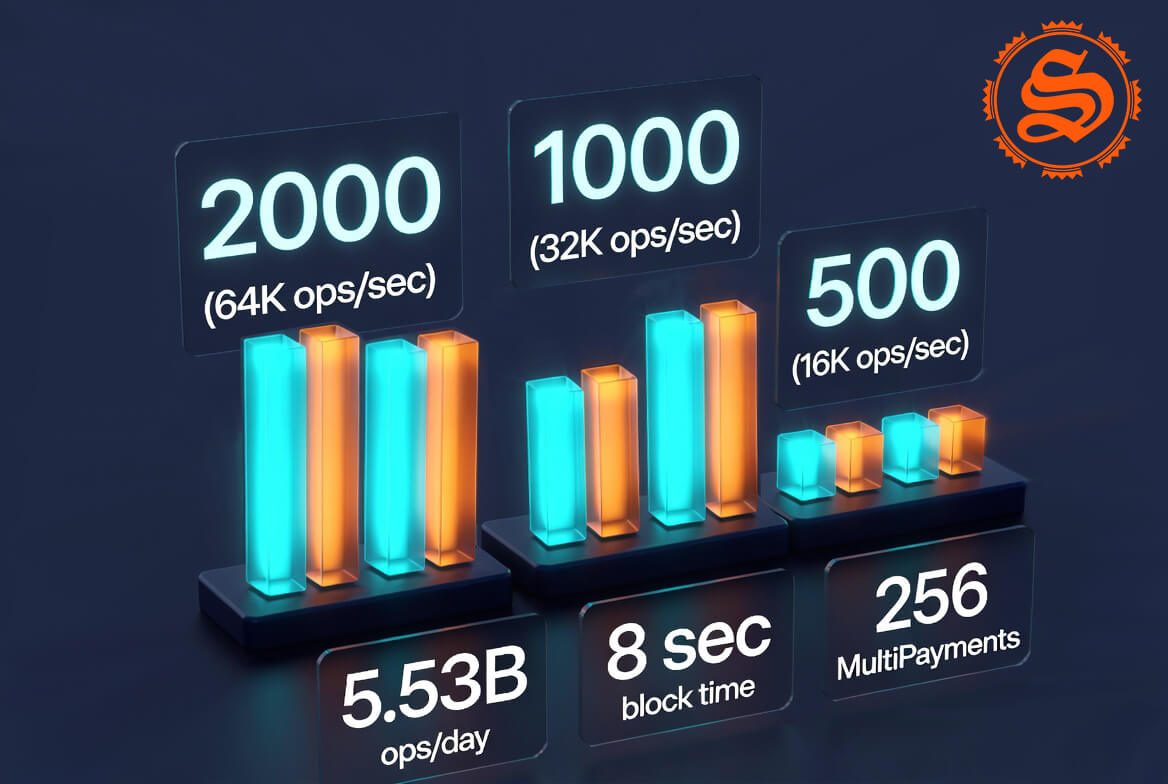
Performance is not theoretical - it is measured. The following benchmarks come from public network stress tests, demonstrating concrete throughput across different transaction configurations:
256
MultiPayments per TX
5.53B
Ops / Day (peak)
| Configuration | Ops / Second | Ops / Hour | Ops / Day |
|---|---|---|---|
| 2000 TX/block (MultiPayments) | 64,000 | 230.4M | 5.53B |
| 1000 TX/block (MultiPayments) | 32,000 | 115.2M | 2.76B |
| 500 TX/block (MultiPayments) | 16,000 | 57.6M | 1.38B |
Under the Hood
Technical Stack
Core Blockchain
- Language: TypeScript / JavaScript (87.4% TS)
- Consensus: DPoS (Delegated Proof of Stake)
- Active Delegates: 21 forging nodes
- Cryptography: secp256k1 (BIP-schnorr signatures)
- Architecture: Modular packages (core, crypto, P2P)
API & SDK
- RESTful API with comprehensive endpoints
- Official SDK client for seamless integration
- Resources: Blocks, Transactions, Delegates, Wallets, Locks, Businesses, Bridgechains
- Real-time node status, peer discovery, round management
Web 4.0 Integration
- Native support for autonomous agent transactions
- Content-addressed state via BLAKE3 verification
- P2P-first architecture with Iroh QUIC transport
- Zero-infrastructure deployment model
True Decentralization
Governed by the Community, Not Corporations
Decentralization is fundamental. The SmartHoldem DPoS blockchain is immutable, and all operations are irreversible. Any transaction is transparently available for viewing on the Block Explorer or via API at any time.
Democratic Voting
Validators are chosen based on reputation, not centralized control.
No Frozen Coins
Users vote with the power of their balance. Coins remain under complete user control.
Accountability
Any STH holder can vote, elect, or cancel delegates. Ineffective delegates are swiftly replaced by the community.
Ownership
Holding just >1 STH grants full voting rights on the network.

The Delegate System
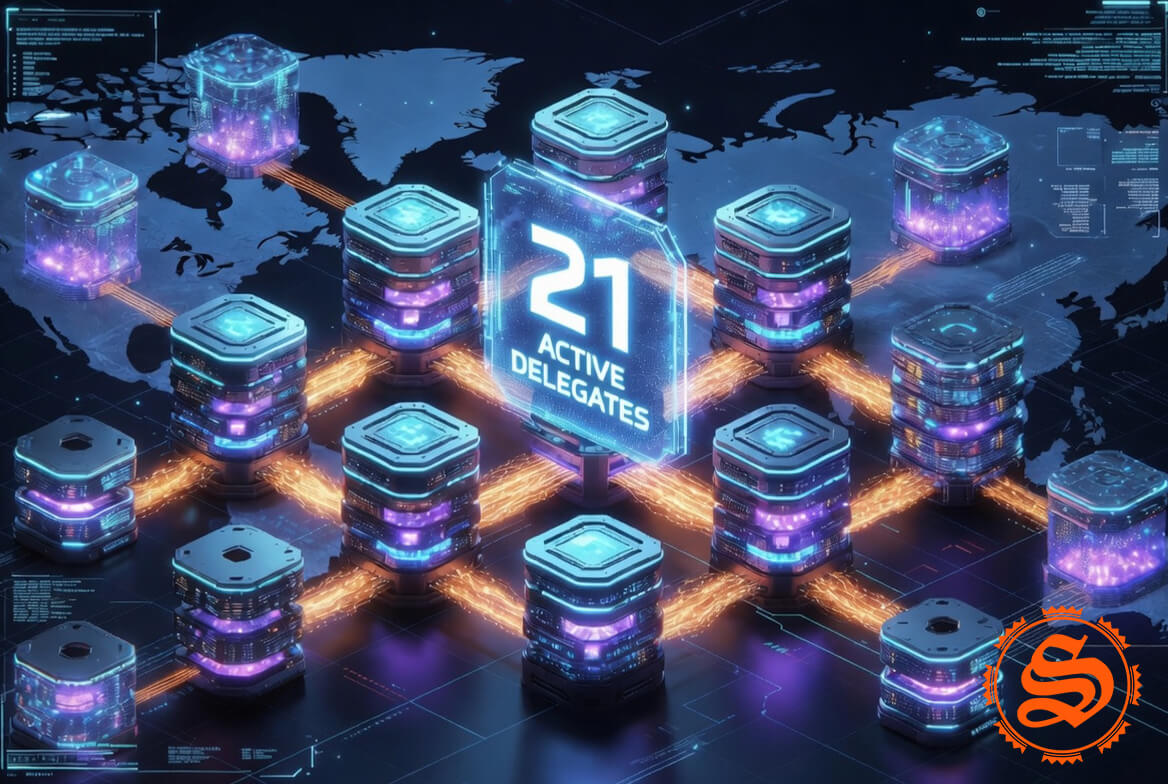
The TOP 21: Securing the Network
Delegates (also known as witnesses or block producers) are responsible for verifying transactions, creating new blocks, and protecting the SmartHoldem network. They cannot alter or influence transaction information.
21
Active Delegates in TOP
8s
Average Block Time
100%
Community Voted
0%
Centralized Control
The delegation system is highly competitive. A delegate can move into or out of the TOP 21 at any time. This sustainable scheme provides an opportunity for new delegates to prove themselves and attract the community's attention.
Economics
Sustainable Rewards. Zero Inflationary Emission.
There is no emission in the SmartHoldem (DPoS) blockchain. Delegates receive rewards exclusively from transaction fees, ensuring a deflationary, sustainable economic model.
The delegate who signs the block receives ALL NETWORK FEES for the transactions included in that block.
How Delegates Earn
500 STH
per block (max)
500 standard transactions in a block → up to 500 STH earned.
10,000 STH
registration fee
Delegate registration transaction → 10,000 STH earned.
0 STH
no base reward
No transactions in a block → 0 STH earned (no base reward).
Advanced Transaction Types
SmartHoldem supports a rich ecosystem of transaction types, generating diverse fee revenue:
Participate
Become a SmartHoldem Delegate
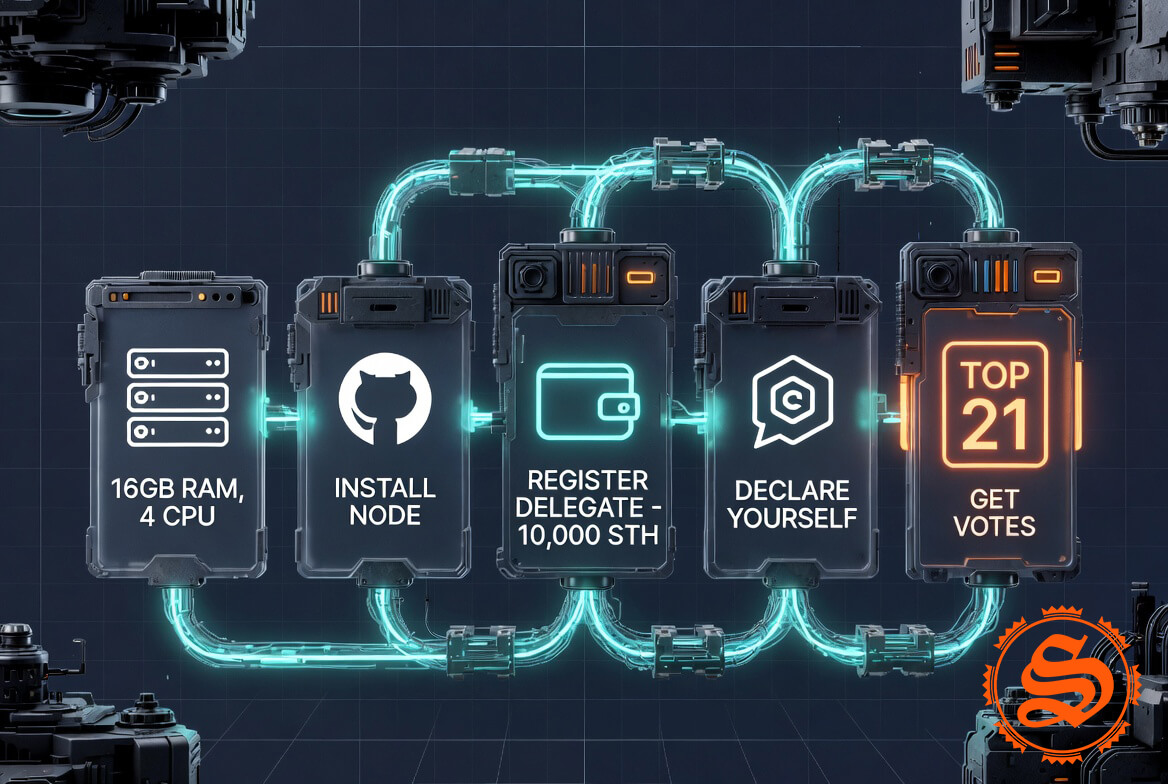
Anyone can become a delegate. All you need is a reliable server and active participation in the SmartHoldem community.
Recommended Server Specs
16 GB RAM, 4 CPU Cores, 64 GB HDD or 32 GB SSD. (Quality networks recommended over cheap VPS).
- 1
Register
Register your delegate in the SmartHoldem Wallet. Transaction cost: 10,000 STH.
- 2
Setup Node
Install and configure your full node at github.com/smartholdem/sth-core.
- 3
Declare
Submit a proposal in the Community Forum detailing your network configuration, proposed payout percentage, and additional services.
- 4
Engage
Introduce your delegate to the community via Telegram and active outreach.
- 5
Grow
Attract votes by offering a percentage of your rewards to voters, building new dApps, or providing community services (code reviews, vulnerability reporting).
Community
Community Connection
As a delegate, active participation and connection to the community is vital to getting votes. Generating delegate slots is competitive and requires more than node management.
Building new applications based on SmartHoldem
Offering code reviews and vulnerability reporting
Community outreach and education
Offering a percentage of rewards to voters (to reach TOP 21)
Reward is measured based on the voter's participation share and the delegate's payout percentage.
Quantum Shield
SmartHoldem Quantum Shield
How We Protect the Blockchain from Future Computers
While the market discusses charts and volatility, a threat capable of nullifying classical cryptography is maturing in the labs of tech giants. Shor's algorithm on a sufficiently powerful quantum computer could break ECDSA (elliptic curves) - the mathematical foundation on which wallets and transactions for most blockchains, including SmartHoldem, are built today.
We aren't waiting for a hypothetical "Day X." The integration of Post-Quantum Cryptography (PQC) into the SmartHoldem ecosystem has already begun.
Roadmap
Implementation Plan: Hybrid Model
We are ruling out abrupt hard forks and forced migrations. The transition will be gradual and seamless:
Phase 1
Hybrid Signatures
- Transactions signed simultaneously with classic ECDSA and new PQC algorithm (e.g., Dilithium)
- Even if one method is compromised, the other maintains protection
Phase 2
Updating STH-Core
- SmartHoldem node is written in TypeScript/Node.js
- Integrate optimized PQC libraries in Rust or C++ via node-addon-api
- Maintain high throughput of the DPoS network without sacrificing cryptographic strength
Phase 3
Quantum Addresses
- Introduction of new address type with extended public keys resistant to quantum analysis
- Users can gradually transfer funds to "Quantum-Safe" wallets
Architecture
Hybrid Quantum Shield via Second Signature
SmartHoldem leverages a unique architectural feature - the second signature mechanism, unlike many other networks where users would have to create new wallets and mass-transfer assets.
Address Formation
An address in SmartHoldem is formed as a hash of the first public key.
Second Key Activation
When the second signature is activated, a second public key is recorded on the blockchain.
PQC Replacement
We replace the generation of this second key from ECDSA with a post-quantum algorithm.
Result
- You do not need to change your wallet
- Your address remains the same
- Your coins stay exactly where they have been for years
- Now protected by a second cryptographic layer
- Even if a quantum computer computes your first private key, it cannot send a transaction without a valid second (quantum-resistant) signature
For users on a single signature: You will need to either activate a second signature (which instantly enables quantum protection) or transfer funds to the new address types once they are released.
Deep Tech
Technical Nuances & Network Protection
Delegates Under Protection
- In a DPoS network, delegates sign blocks
- Forging their signatures threatens the entire blockchain's integrity
- Implementing PQC at the protocol level makes SmartHoldem a "digital fortress" resistant to consensus spoofing
Transaction Size
- Hash-based schemes (Lamport/SPHINCS+) generate signatures sized in kilobytes
- Node logic will be adapted to correctly process "heavy" transactions without losing sync speed
OTS Optimization
- To avoid bloating the blockchain, one-time keys will be aggregated into Merkle trees
- For the user, this looks like a familiar wallet
- At the mathematical level, each key is used strictly once and invalidated after signing
Development
Code in Progress
We are already preparing the infrastructure for the new verification layer. Here's a glimpse of how the integration will look in the core:
// STH-Core: Verification layer
if (transaction.secondSignature) {
  // Classic verification
  verifyClassicSignature(transaction.signature, transaction.senderPublicKey);

  // TODO: Integrate Post-Quantum verification layer
  // validateHybridQuantumSignature(transaction.pqSignature, algorithm: 'Dilithium' | 'SPHINCS+');
}
Quantum supremacy is not the end of cryptography, but its next evolutionary stage. SmartHoldem isn't adapting retroactively. We are laying the foundation for the future today. We are choosing mathematics that cannot be "solved" by brute force and integrating it directly into the core of our DPoS network. The future is already here. And it is secured.
Join the Network
Secure the Future of Decentralization
Join the 21 guardians of the SmartHoldem network. Become a delegate, earn rewards, and help build the Web 4.0 infrastructure.