Netfory Web 4.0 vs. IPFS and Filecoin: Why Economic Incentives and Iroh QUIC Make Decentralized Storage Actually Work
The IPFS protocol revolutionized content addressing. In practice it hit a hard limit: no built-in economic model.
Classic IPFS relies on altruism. Files disappear, nodes go offline, and users fall back to centralized Web2 HTTP gateways that can be censored at any time.
Filecoin tried to close the gap. It sits on the same software as IPFS and adds an incentive layer that pays storage providers. Deals are recorded on-chain and providers must submit Proof-of-Replication and Proof-of-Spacetime. It works, but it is a rental market. Warm storage starts around $2.50 per TiB per month and deals expire. When the deal ends, the data is gone unless renewed. It is not a native distribution layer for applications that need to stay online.
Netfory, built on the SmartHoldem blockchain and SmartNet architecture, solves the problem differently. Reliability is enforced by cryptography. Availability is driven by direct financial motivation.
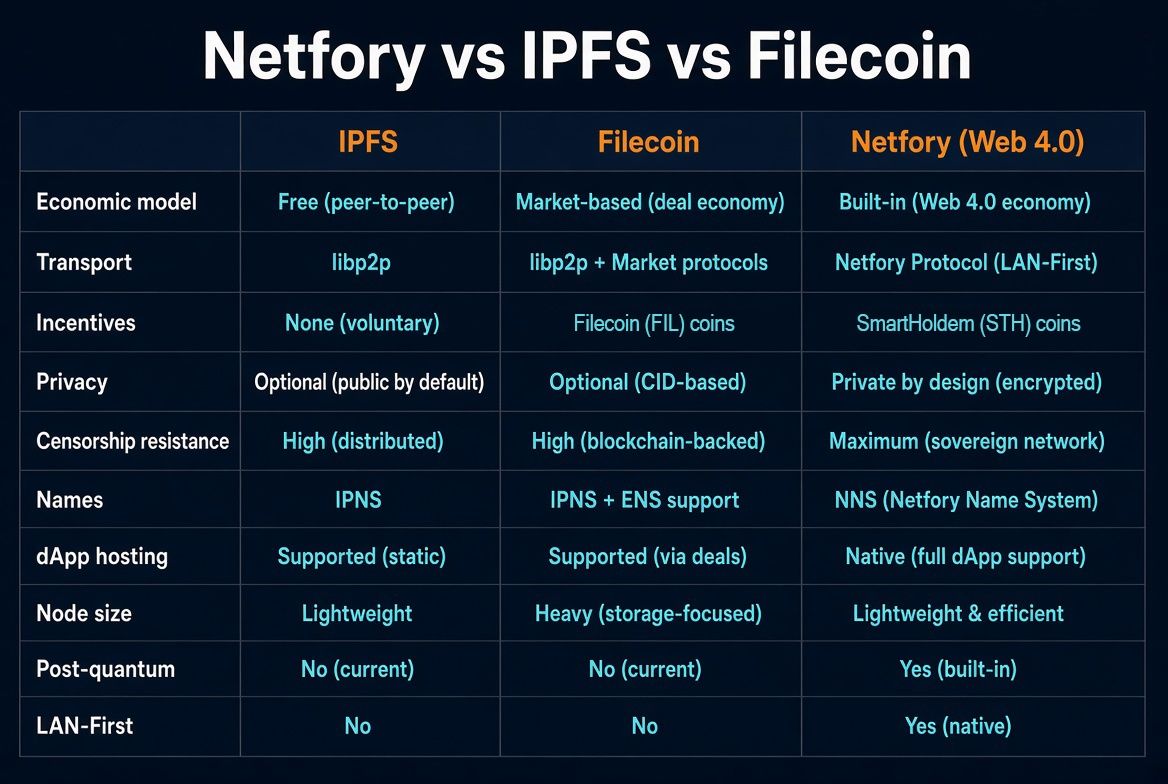
Here are the main architectural differences:
1. The End of the Altruism Paradox: Proof-of-Utility vs. Free Pinning
IPFS has no incentive to seed. Filecoin solved it with a storage marketplace, but that marketplace is designed for renting disk space, not for keeping a website or dApp online indefinitely. Netfory solves it at the protocol level with Proof-of-Utility.
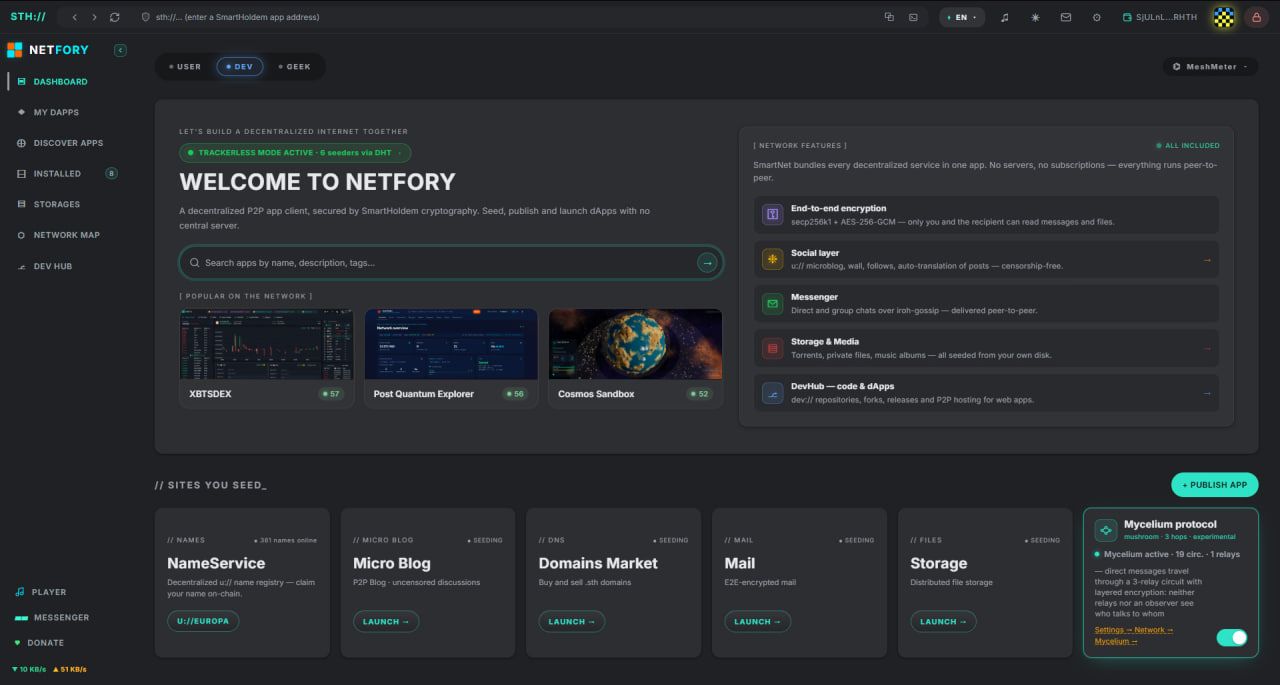
A seeder is an autonomous headless node (Rust) that runs on a VPS or ordinary hardware and redistributes content 24/7. It broadcasts signed heartbeats every 5 minutes. Trackers use these heartbeats to calculate an uptime coefficient and pay the seeder in STH proportional to real uptime and the volume of data it serves.
Key principles:
- One peer is enough. Content stays online as long as at least one peer holds a copy.
- Zero infrastructure. No public IP, no port forwarding, no AWS required. A home connection or cheap VPS is sufficient.
- Direct rewards. Seeders earn STH for storage and bandwidth. No middlemen.
- LAN-First survival. When the global internet is cut, nodes keep working on the local network via mDNS.
Seeders run on Iroh (QUIC). This gives direct peer-to-peer connections even behind strict NATs, zero-RTT reconnection, and an encrypted relay fallback when hole-punching fails. The relay never sees the content.
The desktop client and the headless seeder are the same type of peer. When a user installs an app or site, their client automatically starts seeding it and sending heartbeats. Every user who installs something becomes a seeder.
Content is addressed by BLAKE3 and stored as encrypted blobs. The seeder operator cannot see what is being stored.
2. Next-Gen Transport: Iroh QUIC vs. Heavyweight libp2p
The libp2p stack used by IPFS and Filecoin often struggles with NAT traversal and connection setup.
Netfory uses Iroh (QUIC/UDP):
- Instant connection (0-RTT): session resumption happens with zero delay.
- Native NAT traversal (hole punching): nodes form direct encrypted peer-to-peer connections even behind strict ISP firewalls. No static IP or central tracker required.
- BLAKE3 verification: every chunk is verified on the fly. BLAKE3 is roughly 25× faster than SHA-256, so real-time integrity checks stay practical at network scale.
- Encrypted relay fallback: when direct hole-punching fails, packets are forwarded through a decentralized relay mesh. The relay never sees plaintext. The implementation lives in the NETFORY/pq repository.
3. Cloud Seeders: Absolute Censorship Resistance
If an ISP blocks UDP or known P2P ports, classic IPFS and Filecoin lose connectivity.
Netfory has a fallback. When a direct P2P connection is impossible, the client takes a snapshot of the application, encrypts it with ChaCha20-Poly1305, signs it with the author’s ECDSA key, and uploads it to a public cloud as an ordinary file. This works alongside the encrypted relay mesh.
The ISP sees only encrypted data. Tampering is prevented by the signature. Any user can still download and decrypt the dApp via a public link even under heavy regional filtering. The network continues.
4. Privacy Without Compromises (E2EE)
In IPFS and Filecoin everything is public by default. Hiding data requires custom overlays.
In Netfory privacy is native:
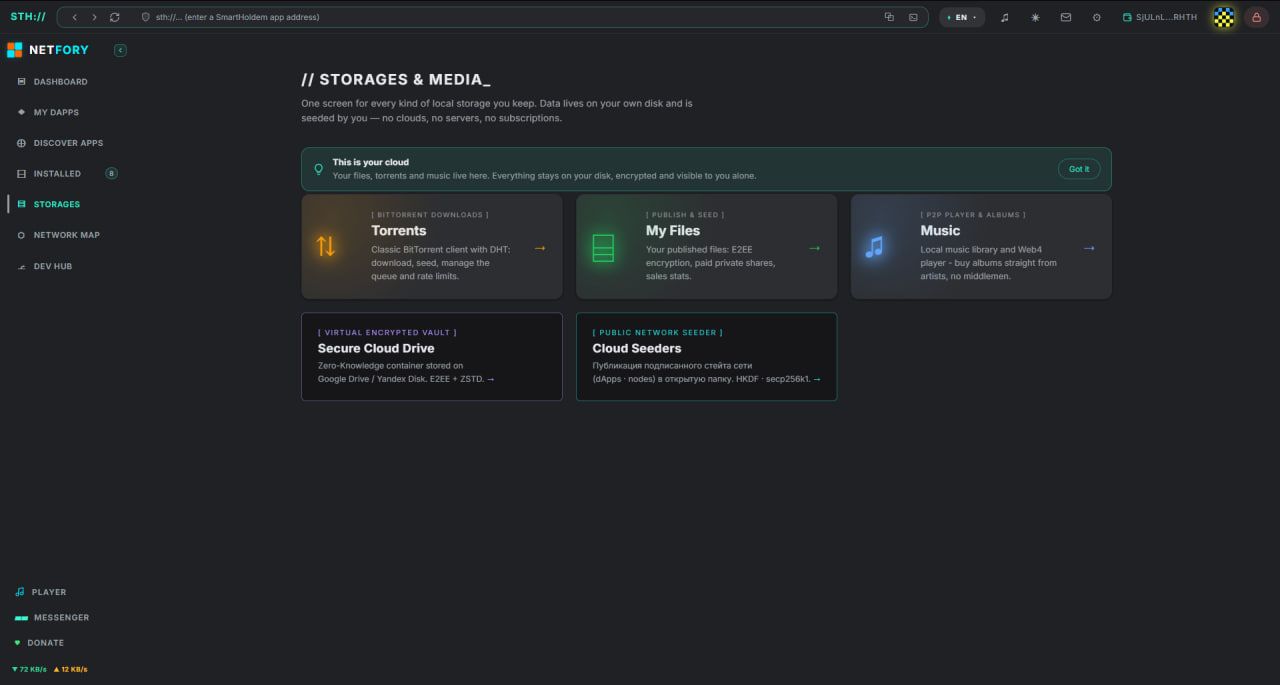
- Private dApps and files are encrypted with AES-256-GCM before they enter the P2P network.
- Messaging uses X25519 key exchange plus AES-256-GCM.
- Seeders only distribute encrypted chunks and cannot read the content.
- The access whitelist lives on-chain in SmartHoldem. Removing an address from the list updates session keys; older versions become unreadable to that address.
5. Human-Readable Domains and Direct Monetization
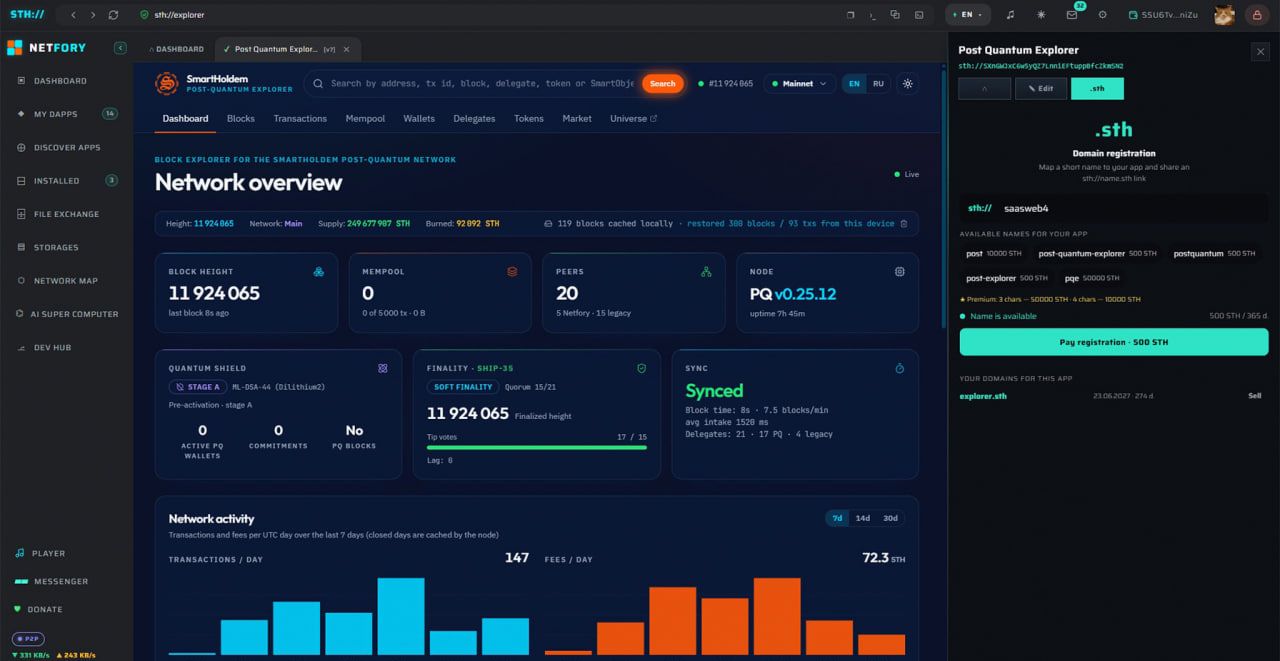
Forget long IPNS hashes or expensive ENS gas fees. In Netfory domains such as u://myapp.sth are anchored to the owner with a lightweight transaction on the SmartHoldem DPoS chain (8-second finality).
The owner chooses the registration period (from 1 year up to 100 years). This prevents permanent squatting: if the owner disappears, the name eventually returns to the pool.
Want to sell software? Set a price in STH directly in the app manifest. The user pays the developer. No platforms, no app stores, 0 % commission.
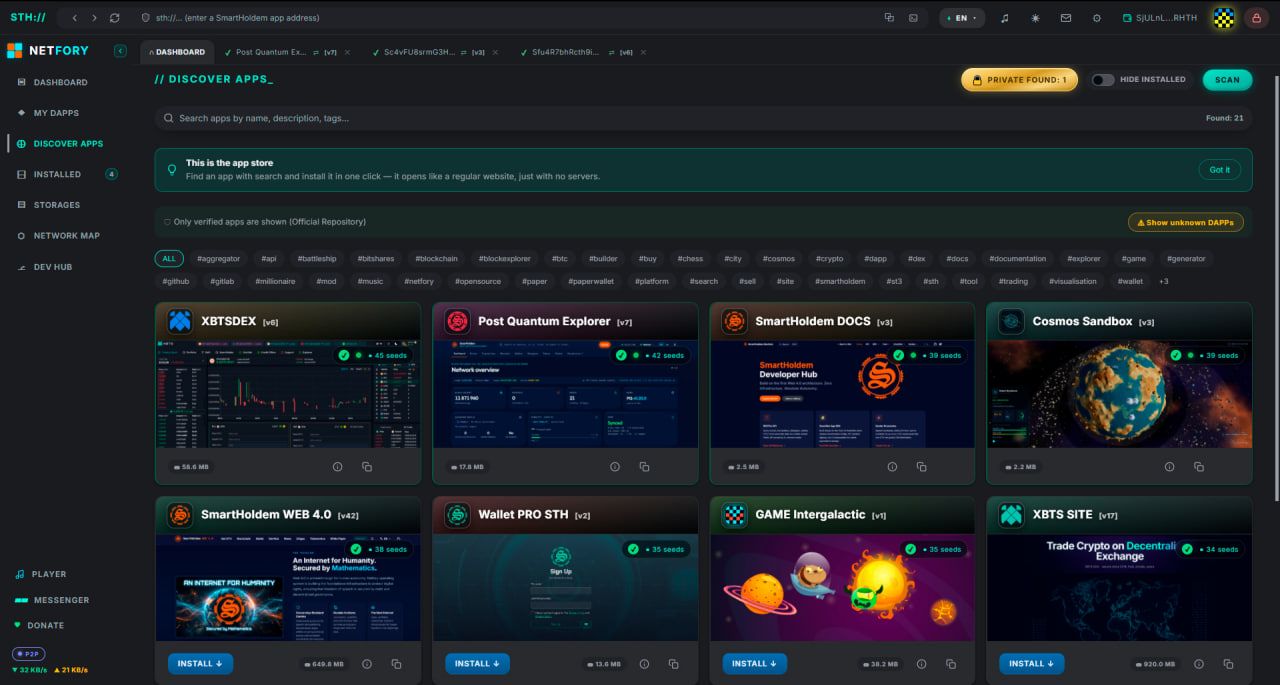
Native dApp Store: Publish Without Permission
Netfory includes a built-in decentralized app store. No gatekeepers, no platform fees, no approval queue. Anyone can publish a dApp or static site directly to the P2P network.
How it works:
1. Prepare your bundle (a dist/ folder with index.html and assets).
2. Open the Developer panel in the Netfory dashboard → DEV → MY DAPPS.
3. Drag the dist/ folder into the upload area.
4. Add name, description, and optional logo. The client crops the preview automatically.
5. Preview in the built-in browser.
6. Publish for free (you must keep seeding until other peers download it or the app is approved for the official catalog) or pay a listing fee for immediate inclusion without the seeding requirement.
After publishing:
- Open the app in a new tab. The globe icon shows the .sth domain.
- You can register additional domains for the same site. The site can be updated at any time.
- The dApp is content-addressed and distributed via Iroh. As long as at least one peer seeds it, it stays online.
- The registry is maintained as an open repository (NETFORY/dapps on GitHub). Developers can also push and clone source code over the P2P network via the git-remote-dev helper.
LAN-First Survival During Blackouts
If the global internet is cut, Clearnet, Tor, IPFS and Filecoin stop working because they depend on external routing and directories.
Netfory is built LAN-First. When the uplink drops, clients switch to local peer discovery via mDNS. E2EE chats, CID-based file transfers and cached applications continue on the local network without any request to the outside world.
Post-Quantum Protection
All on-chain identity and signing operations use Quantum Shield (ML-DSA-44, NIST FIPS 204) together with classic secp256k1. The hybrid scheme remains secure even if one of the algorithms is broken. Names, dApps and messages stay protected against future quantum attacks.
SmartHoldem as the Trust Layer
Netfory relies on the SmartHoldem blockchain as its decentralized trust and settlement layer. SmartHoldem provides on-chain identity (u://), domain registration (.sth), economic anchoring (STH) and 8-second finality BFT).
The SmartHoldem node itself runs on a 100 % Rust core with Sled storage. A full validating node fits in ~8 GB RAM, 4 CPU Cores, 64 GB HDD or 32 GB SSD, so anyone can run one from a laptop or Raspberry Pi. No data center required.
Netfory does not merely patch the problems of IPFS.
It changes how data is stored, moved and paid for.
The user’s device stops being a passive client and becomes a full Web 4.0 agent: it verifies data with BLAKE3, routes traffic directly with Iroh QUIC, earns by providing resources through Proof-of-Utility, and stays autonomous with LAN-First plus Cloud Seeders.
Servers are no longer required. The future is decentralized, and it is already running.
Learn more:
Headless, GUI-less P2P seeder for the SmartNet network: https://github.com/NETFORY/seeder
SmartHoldem blockchain: smartholdem.io/blockchain
Full technical specification: smartholdem.io/white-paper
Download Netfory Web 4.0 OS: github.com/NETFORY/netfory-releases
Key Takeaways
IPFS lacks an economic model. Files disappear without altruistic pinning, and users fall back to centralized gateways.
Filecoin rents storage, not distribution. It adds incentives but remains a storage marketplace with expiring deals, not a native layer for dApps.
Netfory closes the loop with Proof-of-Utility. Seeders earn STH based on uptime and data volume, so availability is financially sustainable.
Iroh QUIC solves NAT traversal. Nodes connect directly behind home routers, no static IP or data center required.
Publishing is permissionless. The native dApp store lets anyone deploy a site or dApp, with .sth domains and zero platform commission.
The SmartHoldem blockchain is the trust layer. Identity, domains, economics, and 8-second finality are anchored on-chain, while content lives on peers.
FAQ
What is Netfory?
Netfory is a Web 4.0 operating system and P2P distribution network built on the SmartHoldem blockchain. It replaces centralized hosting with content-addressed storage, Iroh QUIC transport, and Proof-of-Utility incentives.
How is Netfory different from IPFS?
IPFS relies on altruism and lacks a built-in economic model. Netfory adds Proof-of-Utility rewards for seeders, native dApp publishing, human-readable .sth domains, and E2EE messaging.
How is Netfory different from Filecoin?
Filecoin is a storage marketplace with expiring deals and cryptographic proofs of storage. Netfory is a distribution layer for applications: content stays online as long as peers seed it, and publishing is permissionless.
What is Proof-of-Utility?
Proof-of-Utility is Netfory's incentive model. Seeders broadcast signed heartbeats every 5 minutes; trackers compute an uptime coefficient over a 24-hour window, and rewards scale with uptime and data volume.
Do I need a static IP or data center to run a node?
No. Iroh QUIC provides native NAT traversal and hole punching, so a full validating node can run from a laptop or Raspberry Pi behind a home router.
How do I publish a dApp or website on Netfory?
Create a dist/ folder with index.html, open the Developer panel in the Netfory client, upload the folder, add metadata and a preview image, then publish. You can register unlimited .sth domains per site.
Is domain registration permanent?
No. Domains are registered for a chosen period (from 1 year up to 100 years). This prevents permanent squatting and dead links if an owner disappears.
Is Netfory quantum-resistant?
Yes. On-chain identity and signing use Quantum Shield (ML-DSA-44, NIST FIPS 204) alongside classic secp256k1, forming a hybrid scheme secure even if either algorithm is broken.
#Netfory #SmartHoldem #Web4 #IPFS #Filecoin #P2P #DecentralizedStorage #STH