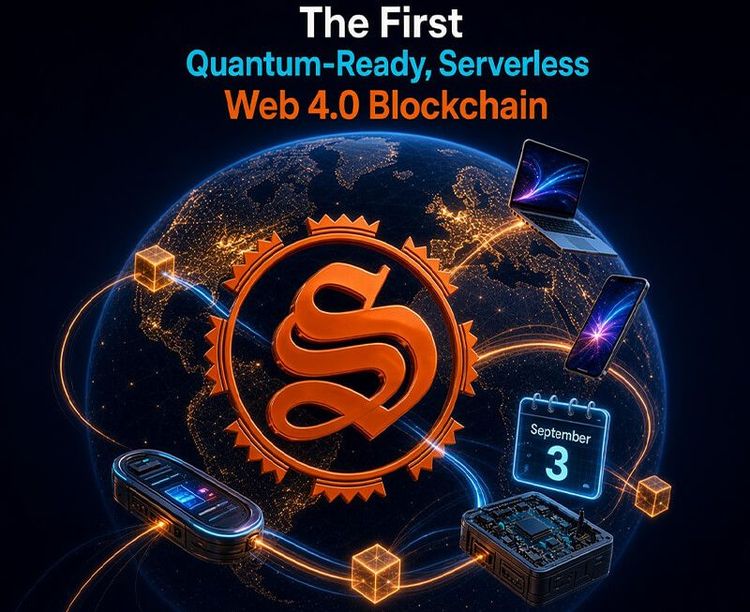

Bitcoin Freed Money. SmartHoldem Frees the Internet
Why Web 4.0 Is the Real Evolution of Digital Sovereignty
When Bitcoin emerged in 2009, it solved one fundamental problem: how to transfer value without trusting a central authority. It introduced decentralized consensus, digital scarcity, and the idea that “code is law.”
Fifteen years later, the crypto industry has delivered DeFi, NFTs, and DAOs. Yet it has failed to solve the most critical challenge of all - building a truly decentralized internet.
Today, the vast majority of so-called decentralized applications still rely on AWS, Cloudflare, and Vercel. A single court order can erase a dApp’s frontend. A Terms of Service violation can shut down an entire project. The backend may be free, but the door to that backend is still owned by corporations.
This is the Frontend Paradox of Web3. And it is why the real question is no longer “Can SmartHoldem become the next Bitcoin?” but rather:
Is SmartHoldem the next logical step after Bitcoin?
Bitcoin Was Layer 0. SmartHoldem Is Layer Everything
Bitcoin and SmartHoldem are not competitors. They solve different problems at different layers of the stack.
- Bitcoin decentralized money. It gave the world a trustless store of value and a settlement layer.
- Ethereum decentralized computation. It introduced smart contracts and programmable money.
- SmartHoldem Netfory OS decentralizes physical infrastructure. It delivers a sovereign internet where users, not corporations, own hosting, communication, and identity.
Bitcoin proved that a network could survive without a CEO.
SmartHoldem proves that an entire internet can survive without a cloud provider.
The Three Pillars That Make SmartHoldem Different
1. Physical Decentralization, Not Just Ledger Decentralization
Most blockchains only decentralize the ledger. Applications, websites, and data still live on centralized servers.
SmartHoldem goes further. Through the Netfory Web 4.0 OS, every user with a spare hard drive or VPS can become a Seeder - a node that stores content, routes traffic, and hosts applications.
No AWS account to hack.
No Cloudflare project to delete.
No Vercel deployment to revoke.
Content is addressed via BLAKE3 hashes and distributed across a dynamic swarm. If one node goes offline, thousands of others keep the data alive. This is the architecture of a digital lifeboat.
2. Proof-of-Utility, Not Proof-of-Speculation
Bitcoin’s security comes from energy-intensive mining. Ethereum’s comes from staked capital. Both are valid, but neither directly rewards useful work.
SmartHoldem introduces Proof-of-Utility. Seeders earn STH based on real contributions: storage provided, bandwidth delivered, and uptime maintained.
The transparent formula is:
`(Base + seededGb × density + activeApps × PerApp) × K_up`
This creates a self-sustaining economy where participants are rewarded for actual infrastructure work. It is the economic engine of a true Decentralized Physical Infrastructure Network (DePIN).
3. LAN-First Resilience: Survival When the World Goes Dark
In a world of fiber cuts, regional blackouts, and internet shutdowns, traditional networks, including Bitcoin and Ethereum, fail. They require global connectivity to function.
Netfory is designed with a LAN-First paradigm. When the global connection drops, clients automatically switch to local peer discovery via mDNS. Your local network becomes a sovereign island:
- E2EE chats continue between neighbors
- File sharing via CID works at full speed
- Cached dApps remain fully functional
This is not just a technical feature. It is a human rights feature. In regions where governments shut down the internet, Netfory keeps communities connected.
The Deflationary Model: Why STH Is Not Just Another Coin
Bitcoin’s supply is capped at 21 million. SmartHoldem took a different path: block emission has been completely halted.
The STH coin is now strictly deflationary. Supply decreases over time through burning mechanisms for:
- Name registrations
- dApp publications
- Transaction fees
Every time a developer registers a `u://` name, a user sends an anti-spam invite via 0xID Mail, or a dApp is published to DevHub, STH is burned. The more the network is used, the scarcer the token becomes.
Reputation Over Censorship
One of the biggest questions about decentralized networks is: “How do you stop scams and malware?”
SmartHoldem’s answer is Reputation over Censorship. The platform uses a two-tier catalog system:
- Official - Apps verified by cryptographic signatures from trusted developers
- All - The full, unfiltered P2P network
We mark. We never censor. Direct `sn://` links always work. By default, users see a safe, verified environment. This balances safety with absolute freedom, something no centralized platform can achieve.
So, Can SmartHoldem Become the Next Bitcoin?
The question is framed incorrectly.
SmartHoldem is not trying to replace Bitcoin. It is trying to complete what Bitcoin started.
Bitcoin freed money from central banks.
SmartHoldem frees the internet from cloud providers.
Bitcoin gave us digital gold.
SmartHoldem gives us digital soil - the ground on which a truly free internet can grow.
If Bitcoin was the first word in the story of digital sovereignty, SmartHoldem is the next chapter.
It is not about price or market cap. It is about building an internet where:
- Developers deploy without fear of deplatforming
- Users communicate without surveillance
- Seeders earn by providing real value
- Communities survive even when the world goes dark
The era of renting your digital existence is over.
The era of the sovereign web has begun.
Don’t visit the web. Be the web.
Push Humanity Forward
Download Netfory WEB4 OS Client https://github.com/NETFORY/netfory-releases
#smartholdem #bitcoin #web4 #netfory #DePIN #humanright #Privacy